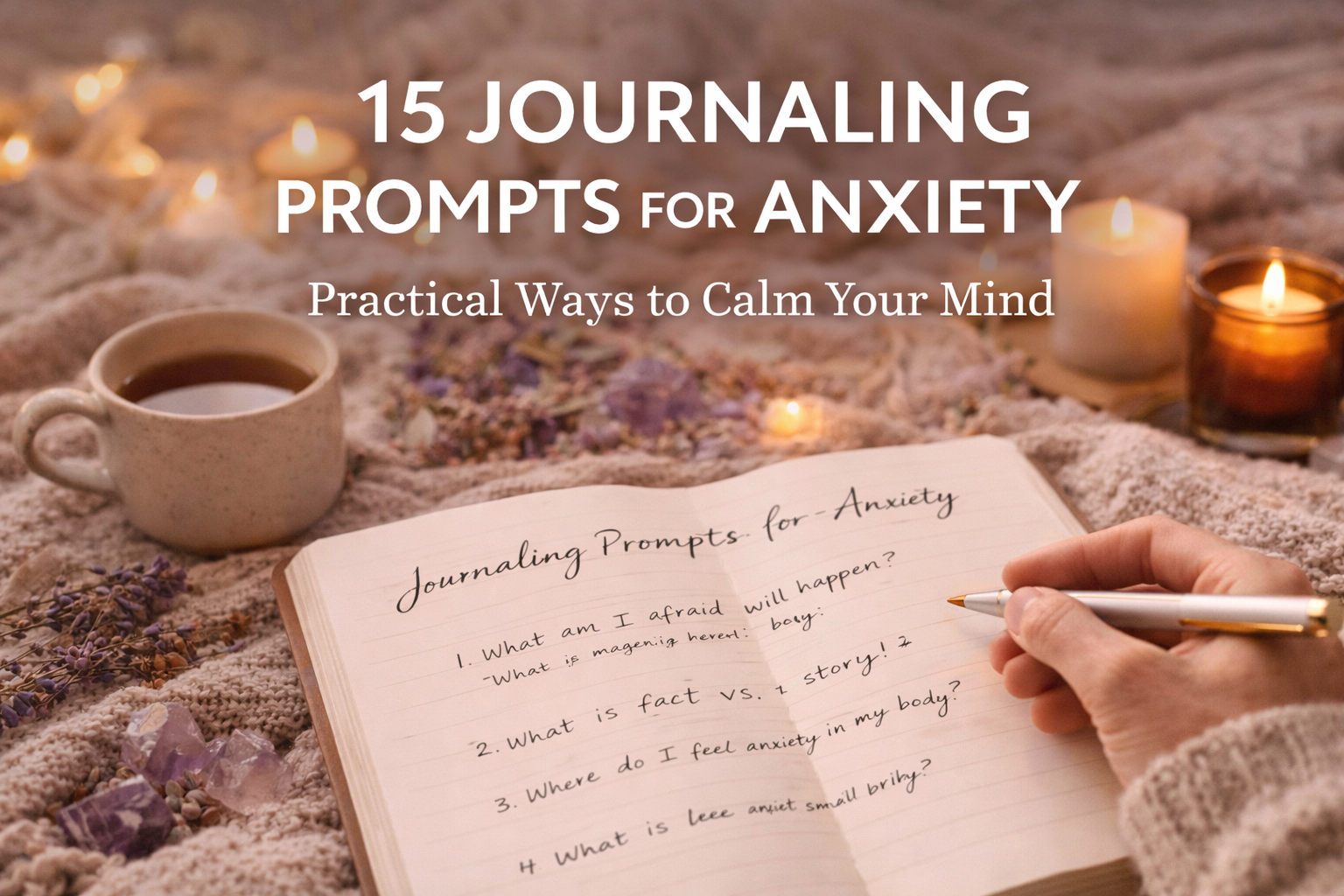
15 Journaling Prompts for Anxiety (That Calm Your Nervous System + Clear Your Mind)
Galina Razumovsky- Sacred Sova, Golden, CO.
Anxiety doesn’t always mean panic. It can show up as overthinking, chest tightness, insomnia, irritability, vague unease, reassurance-seeking, or doom-scrolling.
Here’s the truth: anxiety isn’t a personality flaw. It’s a nervous system state.
Journaling helps because it does two powerful things at once:
- It slows down mental spirals by forcing your brain to create structure.
- It helps your body feel safer because you stop suppressing what you’re feeling.
This post gives you 15 journaling prompts for anxiety that are actually useful — not fluffy quotes, not “just think positive.” These prompts are designed to regulate your nervous system, calm overthinking, and bring you back into clarity.
Why journaling helps anxiety (what’s happening in your brain)
Anxiety thrives on uncertainty and fear stored in the body. Writing activates the brain’s logic center, reducing chaos.
Journaling creates containment.
Instead of thoughts running wild in your head, they land on paper where you can see them clearly. Once something is clear, it becomes workable.
How to use these journaling prompts (so it actually works)
Before you start, do this 30-second reset:
Put one hand on your chest, one on your belly. Inhale slowly through the nose. Exhale longer than inhale. Then quietly say: “I am here. I am safe enough in this moment.”
Now use this simple journaling method:
The Sacred Sova 3-Step Anxiety Journaling Method
Step 1: Write down the thoughts and feelings that are most prominent for you right now. Spend 2 minutes writing freely without filtering. Step 2: Pick 1–3 prompts from the list below. Spend 5–15 minutes writing your honest answers to these prompts, focusing on your current experience.
Step 3: Finish your journaling by making one clear choice—set a boundary, decide on an action step, or write a statement of surrender. This step helps you close the session feeling grounded.
Rule: The purpose of journaling is to process and release anxiety, not to dwell on it or make it stronger. Stay focused on moving through and out of anxious states.
15 Journaling Prompts for Anxiety
Choose the prompts that match your current emotional state. Don’t overthink your answers — write fast and honestly. This is a nervous system practice, not a homework assignment.
1) Prompts to stop spiraling and come back to the present
1. What are the facts right now — without interpretation?
Write what is true in observable reality.
Example: “I sent the email.” “They haven’t responded.” “My chest feels tight.”
Not: “They hate me.” “I’m going to lose everything.”
This prompt separates the event from the story, which immediately reduces panic.
2. What exactly am I afraid will happen?
Name the worst-case scenario in one clear sentence. Anxiety thrives in vagueness. Clarity weakens it.
3. What is the most likely outcome, realistically?
This breaks fear-trance and brings you back into probability. If your mind says “everything will collapse,” ask it to back the claim with real evidence.
2) Prompts to uncover the real fear underneath the anxiety
4. If this goes wrong, what would it mean about me?
This is one of the most powerful prompts because anxiety is often not about the event — it’s about identity.
Examples: “It means I’m not enough.” “It means I’m unsafe.” “It means I’m alone.”
When you name the belief, you stop being possessed by it.
5. What is this anxiety trying to protect me from feeling?
Often, it’s protecting you from grief, anger, shame, disappointment, or heartbreak. Anxiety can act like an emotional bodyguard.
6. When have I felt this exact feeling before?
Don’t look for the same situation—look for the same sensation. This helps uncover patterns like rejection fear or perfectionism.
3) Nervous system prompts (because anxiety lives in the body)
7. Where do I feel anxiety in my body right now?
Be specific: throat, jaw, stomach, shoulders, chest, pelvis. Describe the texture: pressure, buzzing, heat, tightness, or heaviness.
8. What does my body need right now — not my mind?
Examples: water, food, movement, quiet, warmth, sunlight, a shower, a walk, or to lie down. This prompt is the difference between healing anxiety and intellectualizing it.
9. What would calm look like in my body?
Describe calm like a destination: “My shoulders drop.” “My belly softens.” “My breath slows.” “My jaw unclenches.” Your nervous system learns safety through repetition and imagery.
4) Prompts that reduce self-attack and rebuild self-trust
10. What would I tell a friend if they were in my exact situation?
You likely would not say they are failing, inadequate, or broken—yet many people use those words about themselves. Instead, write with compassion.
11. What have I survived before that proves I can handle discomfort?
List at least five moments. Anxiety says, “You can’t handle this.” Your history proves otherwise.
12. What is one thing I know for sure — even with uncertainty?
Examples: “I can take one step.” “I can ask for support.” “I’m allowed to rest.” “I don’t need to solve my entire life today.” This builds inner stability.
5) Boundary + action prompts (so you don’t stay stuck)
13. What am I trying to control that I need to release?
Common answers: other people’s emotions, timelines, perfection, the outcome, the past. Letting go isn’t weakness — it’s nervous system maturity.
14. What boundary would lower my anxiety by 10% this week?
Examples: say no, limit social media, stop over-explaining, protect sleep, and end draining conversations earlier. Anxiety often decreases when boundaries increase.
15. What is the smallest next step I can take in the next 10 minutes?
Make it tiny: drink water, send the message, book the appointment, go outside, put the phone away for 20 minutes. Your nervous system trusts movement more than thought.
Bonus: 5 short “emergency prompts” for intense anxiety
If you’re in a high-anxiety moment, use these grounding prompts to interrupt escalation:
- What’s one thing I can see right now?
- What’s one thing I can touch?
- What’s one thing I can hear?
- What’s the next safe action?
- What is NOT required from me right now?
Journaling tips if you overthink too much
If journaling turns into rumination, do this:
- Use time limits: set a 7-minute timer. Stop when it ends.
- Write single-sentence answers: anxiety loves endless processing.
- End every session with one choice: even if the choice is “I will rest.”
- Avoid late-night journaling: it can stimulate the mind unless you close with calm breath.
What to do after journaling (to seal the calm)
After you finish writing, take 60 seconds:
- Put both feet on the floor.
- Inhale for 4 seconds
- Exhale for 6–8 seconds
- Say: “I don’t need to solve everything. I only need to be here.”
You just taught your nervous system something important: you can feel anxiety and still stay present.
Final words: anxiety doesn’t mean you’re broken
Anxiety usually means your system is overloaded, your body doesn’t feel safe, and your mind is trying to predict danger. Journaling is not a “fix.” It’s a way to return to yourself.
Every time you write instead of spiral, you build a new pattern: presence over panic.
Sacred Sova Invitation
If you want deeper guided prompts, emotional clarity, and boundary work, explore The Art of Loving Without Losing Yourself — Sacred Sova’s journal for people who are tired of overgiving, shrinking, and losing themselves in relationships.https://sacredsova.com/the-journal/
Because healing anxiety isn’t only calming down — it’s learning to live without abandoning yourself.
Q: What should I write in my journal when I feel anxious?
A:When you feel anxious, journal about what you’re afraid will happen, what facts are true right now, and what your nervous system needs. Start with prompts like “What is the worst-case scenario I’m imagining?” and “What is the smallest next step I can take today?” This reduces spiraling and brings clarity.
Q: Do journaling prompts actually help with anxiety?
A:Yes. Journaling prompts help anxiety by turning vague fear into specific language, which calms the nervous system and reduces mental looping. Prompt-based journaling is more effective than free-writing because it guides your mind toward clarity instead of rumination.
Q:Can journaling ever make anxiety worse?
A:Yes. Journaling can worsen anxiety if you use it to relive fears without structure, which can turn into rumination. The solution is to use specific prompts, set a time limit (5–10 minutes), and end each journaling session with a grounding step or an action plan.