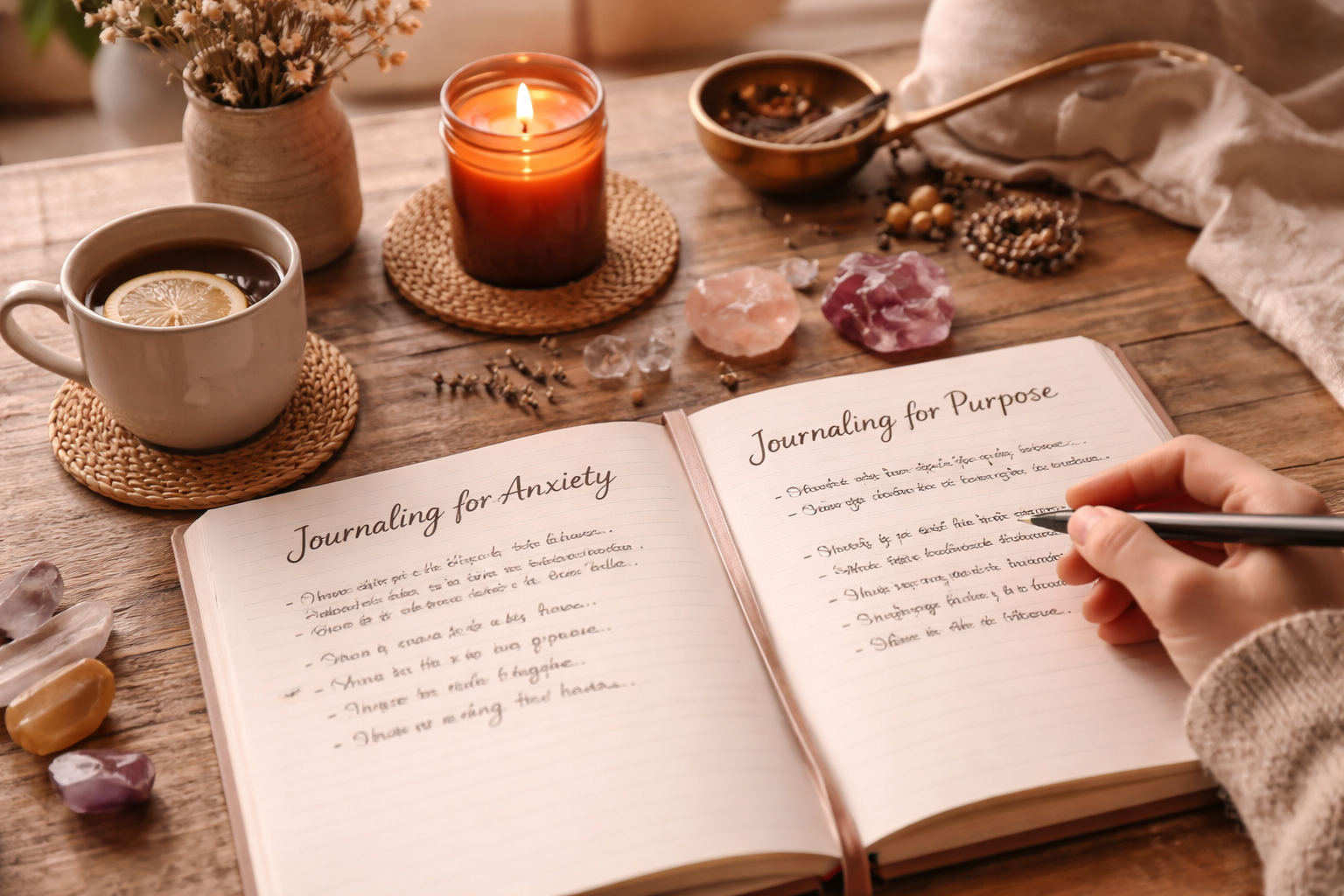
Journaling for Anxiety vs. Journaling for Purpose
Why they’re different — and why confusing them keeps you stuck.
Galina Razumovsky- Sacred Sova, Golden, CO.
Journaling is often recommended as a universal tool, but journaling for anxiety and journaling for purpose serve fundamentally different psychological functions. When used incorrectly or interchangeably, journaling can increase overwhelm rather than create clarity.
Recognizing which kind of journaling you need unlocks true effectiveness and prevents confusion as you shift approaches.
Journaling for Anxiety
Purpose: nervous system regulation
Primary function: emotional discharge and stabilization
Journaling for anxiety is about reducing intensity, not gaining insight.
This type of journaling works best when paired with grounding or meditative practices that calm the body first. Sacred Sova approaches anxiety journaling as part of a broader meditation and nervous-system regulation practice, not as mental problem-solving.
👉https://sacredsova.com/yoga-meditation/
What journaling for anxiety does.
- Releases repetitive, intrusive thoughts
- Lowers emotional arousal
- Creates immediate mental space
- Anchors attention in the present moment
How to do it correctly
- Write what is happening right now.
- Do not analyze, interpret, or fix.
- Stay with sensations, thoughts, and emotions as they are
- Stop once the emotional charge decreases.
Example prompts
- “Right now I feel…”
- “The thought that keeps repeating is…”
- “What sensation do I notice in my body?”
- “What am I afraid will happen?”
Outcome
This is the desired result of anxiety journaling. Now, let’s look at how journaling for a purpose creates its own distinct outcome.
Journaling for Purpose
Purpose: meaning, orientation, and integration
Primary function: clarity and direction
Journaling for a purpose is not a calming technique. It is a reflective practice that works only when the nervous system is already regulated.
This is the foundation of Sacred Sova’s structured spiritual journaling approach, where writing is used to reveal patterns, values, and inner truth rather than discharge emotion.
👉 https://sacredsova.com/the-journal/
What does journaling for a purpose do?.
- Reveals long-term patterns
- Clarifies values and priorities
- Strengthens inner authority
- Helps integrate life experiences into meaning
How to do it correctly
- Journal from a calm, steady state
- Ask open, reflective questions.
- Sit with questions longer than answers.
- Allow ambiguity without forcing conclusions.
Example prompts
- “What feels essential to me now?”
- “Where am I outgrowing my current life?”
- “What part of me is asking to be expressed?”
- “What truth keeps returning, even when I avoid it?”
Outcome
This is a different kind of result than anxiety journaling. Understanding the difference helps you know which tool you need in the moment.
The Core Difference (Clear and Simple)
| Regulates the nervous system | Orients consciousness |
| Reduces emotional intensity | Reveals direction |
| Short-term relief | Long-term clarity |
| Focus on feelings | Focus on meaning |
| “What is happening now?” | “Who am I becoming?” |
Trying to journal for a purpose while anxious usually creates more anxiety.
Trying to calm anxiety through purpose questions usually does not work.
The Correct Order (This Is Critical)
- Journaling for anxiety to stabilize
- Pause — breathe, walk, rest.
- Journaling for the purpose of reflecting and integrating
This same sequence underlies deeper contemplative systems such as the Game of Leela, where grounding awareness must come before insight.
👉 https://sacredsova.com/photo-gallery/
Reverse the order, and you spin. Follow it, and clarity emerges naturally.
Practical Guidance
- Racing thoughts → journaling for anxiety
- Calm but stuck → journaling for purpose
- Unsure → regulate first, inquire second
One clears the fog.
The other shows the path.
Used correctly, journaling stops being emotional dumping and becomes a precise inner tool for transformation.
Continue the Practice
If journaling has helped you regulate anxiety or clarify direction, the next step is consistency and structure.
Sacred Sova journals are designed specifically for conscious self-inquiry — not emotional dumping and not surface-level prompts. They are created to support both phases of the process: calming the nervous system first, then moving into deeper reflection and meaning-making.
You can explore and acquire the Sacred Sova journal directly at the bottom of this page.
Used regularly, the journal becomes more than a notebook. It becomes a quiet, steady companion for your inner work — meeting you where you are, and guiding you forward when clarity is ready to emerge.
Q: Is journaling good for anxiety?
A:Yes. Journaling can help reduce anxiety by externalizing thoughts and lowering emotional intensity. It works best when focused on present-moment experience rather than analysis.
Q: What is the difference between journaling for anxiety and journaling for purpose?
A:Journaling for anxiety regulates the nervous system and provides emotional relief. Journaling for purpose focuses on meaning, clarity, and long-term direction and should only be done when calm.
Q:When should I journal for purpose?
A:Journal for purpose when you feel emotionally stable but unclear, stuck, or at a crossroads. This allows insight to emerge without overwhelm.