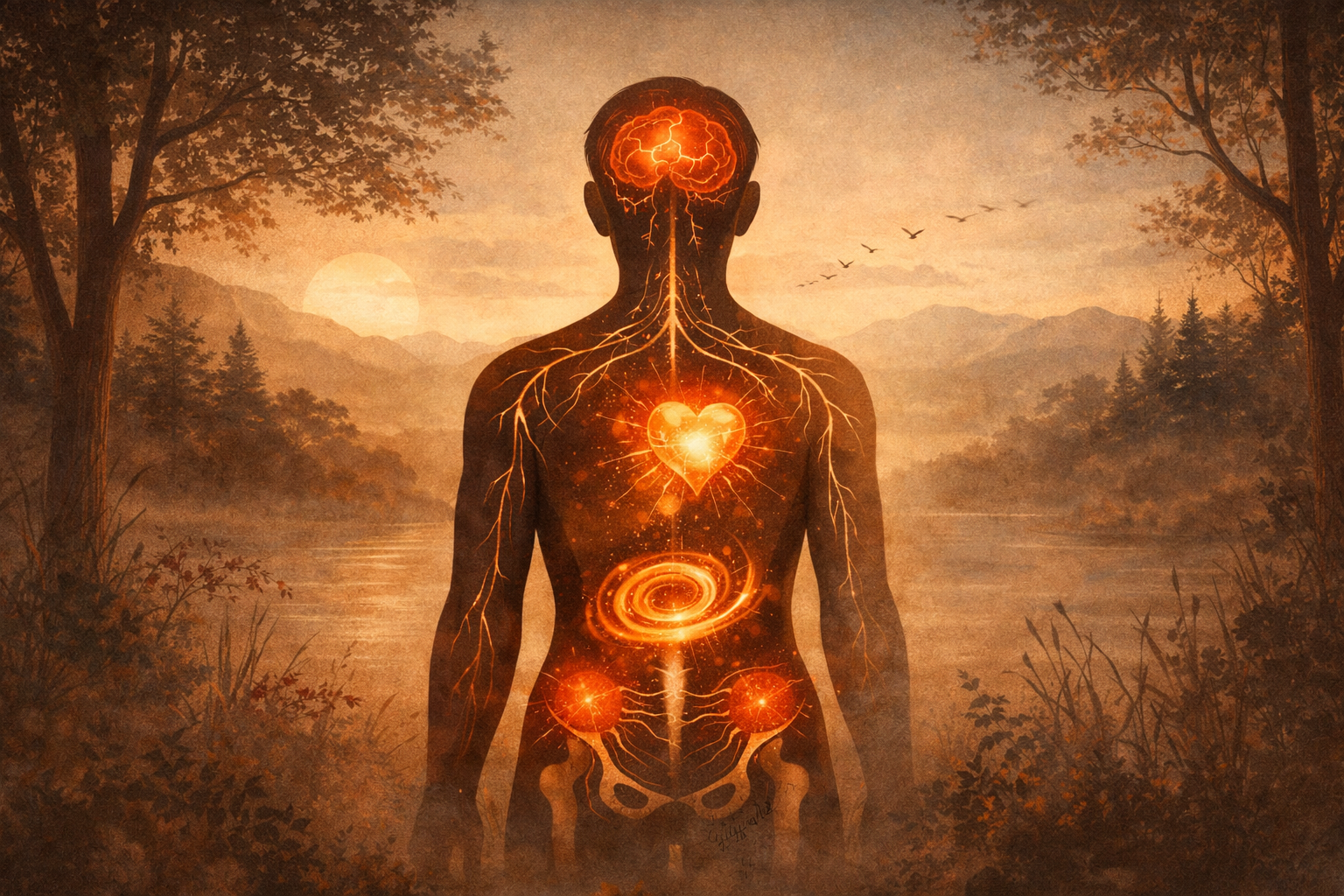
Our Body Keeps the Score: How Your Nervous System Remembers Everything
Galina Razumovsky- Sacred Sova, Golden, CO.
There is a reason you can walk into a room and instantly feel uneasy—without knowing why.
A reason your shoulders tighten when you hear a certain tone of voice.
A reason your body reacts before your mind can explain anything.
Your body remembers.
Not as a story.
Not as a timeline.
But as sensation, tension, breath patterns, and nervous system responses.
This is not philosophy. This is biology.
The Body Is Not Separate From the Mind
For decades, psychology treated the mind and body as separate systems. That model is outdated.
Modern neuroscience shows that your brain, nervous system, immune system, and body are one integrated network. Every experience you go through—especially emotional ones—gets encoded across this system.
When something happens to you:
- Your brain interprets it.
- Your nervous system reacts.
- Your hormones shift
- Your muscles contract or release
- Your breath changes
If the experience is intense or overwhelming, your system doesn’t just “move on.”
It adapts. And it stores.
What Does “The Body Keeps the Score” Actually Mean?
The phrase comes from The Body Keeps the Score by Bessel van der Kolk, a leading trauma researcher.
His core point is simple:
Trauma is not just remembered—it is lived through the body.
Even when you don’t consciously think about past experiences, your body continues to respond as if they are still happening.
Examples:
- Chronic muscle tension from prolonged stress
- Digestive issues linked to anxiety
- Hypervigilance (always “on edge”)
- Emotional numbness or shutdown
- Panic responses without clear triggers
This is not a weakness.
It’s your nervous system trying to protect you.
How the Nervous System Stores Experience
Your body operates through the autonomic nervous system, which has two primary modes:
1. Sympathetic (Fight or Flight)
Activated when your body detects danger.
- Heart rate increases
- Muscles tighten
- Breathing becomes shallow
- Stress hormones (like cortisol) rise
2. Parasympathetic (Rest and Digest)
Activated when your body feels safe.
- Heart rate slows
- Digestion improves
- Muscles relax
- Breathing deepens
There is also a third response often overlooked:
3. Freeze (Shutdown)
When the system is overwhelmed and cannot fight or escape.
- Numbness
- Dissociation
- Low energy
- Emotional detachment
If an experience is too intense and you cannot fully process or complete the response, the nervous system stays partially stuck in that state.
That “unfinished” response becomes stored in the body.
Trauma Is Not What Happened. It’s What Stayed
This is where most people get it wrong.
Trauma is not defined by the event.
It is defined by how your system processed—or failed to process—that event.
Two people can go through the same situation:
- One processes it and moves on.
- The other stores it in the body
Why?
Because trauma is about overwhelm.
When your system cannot safely feel, express, or release what is happening, it suppresses the response to survive.
That suppression doesn’t disappear.
It becomes:
- Tight hips
- Locked jaw
- Shallow breathing
- Chronic fatigue
- Anxiety patterns
Your body adapts to hold what your mind couldn’t process.
The Role of the Brain: Why You Can’t “Think” Your Way Out
The part of your brain responsible for logic—the prefrontal cortex—goes offline under stress.
Meanwhile, the amygdala (your threat detector) becomes highly active.
That means:
- You react before you think.
- You feel before you understand
- You repeat patterns without awareness.
This is why talk therapy alone often hits a limit.
You can understand your patterns intellectually and still feel stuck.
Because the memory isn’t just in your thoughts.
It’s in your body.
Where the Body Stores Stress and Trauma
Research and somatic practices consistently show common areas where the body holds tension:
Jaw and Face
- Suppressed expression
- Unspoken words
- Emotional restraint
Neck and Shoulders
- Chronic responsibility
- Hypervigilance
- “Carrying the weight.”
Chest and Heart Area
- Grief
- Emotional pain
- Anxiety
Diaphragm
- Breath restriction
- Fear response
- Panic patterns
Hips and Pelvis
- Deep emotional storage
- Survival responses
- Long-term tension patterns
This is why practices like yoga often bring up unexpected emotions.
You’re not “creating” something new.
You’re releasing what was already there.
The Body Speaks Before the Mind Understands
Your body constantly gives you signals:
- Tight chest → something feels unsafe.
- Heavy limbs → shutdown or exhaustion
- Restlessness → unresolved activation
- Gut discomfort → emotional stress
Most people ignore these signals.
They override them with:
- Productivity
- Distraction
- Stimulation
- Rationalization
But the signals don’t stop.
They get louder.
And eventually, they become symptoms.
Can the Body Release What It Stores?
Yes. But not through force.
The body does not respond to pressure.
It responds to safety.
This is where most people fail—they try to “fix” themselves aggressively.
That keeps the nervous system in a state of stress.
Real release happens when the body feels safe enough to let go.
What Actually Works (Based on Research and Practice)
1. Breathwork
Slow, controlled breathing directly regulates the nervous system.
- Longer exhales activate the parasympathetic state.
- Deep diaphragmatic breathing releases tension.
This is immediate and measurable.
2. Somatic Awareness
Learning to feel the body without reacting.
This means:
- Noticing sensation
- Staying present with it
- Letting it move without suppression
This is the foundation of somatic therapies.
3. Movement (Especially Slow, Intentional Movement)
Yoga is one of the most effective tools here.
Not performance-based yoga.
But awareness-based movement.
- Slow transitions
- Long holds
- Conscious breathing
This allows stored tension to surface and release.
4. Regulation Before Processing
You cannot heal in a dysregulated state.
First, stabilize the nervous system.
Then process.
This is why grounding practices matter more than analysis.
5. Repetition and Consistency
Your nervous system was shaped over time.
It will not change in one session.
You need:
- Daily regulation
- Consistent awareness
- Gradual exposure to sensation
This is rewiring—not quick relief.
Why This Matters for You
If you feel:
- Stuck in patterns you understand but can’t change
- Anxious without a clear reason
- Physically tense all the time
- Disconnected from your body
You are not broken.
You are carrying unprocessed experience.
Your body is doing exactly what it was designed to do:
Protect you.
But protection becomes a limitation when it never turns off.
The Shift: From Control to Awareness
Most people try to control their minds.
That’s backwards.
Start with the body.
- Regulate the breath
- Soften the muscles
- Slow the system down.
Then the mind follows.
Not the other way around.
The Sacred Sova Perspective
At Sacred Sova, the work is not about forcing change.
It’s about returning to awareness.
Through:
- Breath
- Movement
- Stillness
- Reflection
You begin to feel again.
And when you truly feel—without resistance—
The body starts to release what it no longer needs to hold.
This is not instant.
But it is real.
Final Truth
Your body remembers everything.
Not to punish you.
But to protect you.
When you stop fighting it—
and start listening—
That’s when healing actually begins.
Suggested internal links for your WordPress post:
- Anchor: guided journaling practices → https://sacredsova.com/the-journal/
- Anchor: yoga and meditation sessions → https://sacredsova.com/yoga-meditation/
- Anchor: explore more insights → https://sacredsova.com/blog/
The journey inward never ends — only deepens.
When you’re ready for more, the owl knows where to find you.
— Sacred Sova
Questions and Answers:
Q: What does “the body keeps the score” actually mean?
A:It means your body stores experiences—especially stress and trauma—not as stories, but as physical patterns. These show up as muscle tension, breathing habits, nervous system responses, and emotional triggers. Even if your mind moves on, your body can continue reacting as if the experience is still happening.
Q:Can trauma really stay in the body without conscious memory?
A:Yes. The body and nervous system can store unresolved experiences without you actively remembering them. This is why people often feel anxiety, tension, or emotional reactions without a clear reason. The body is responding based on past patterns, not present reality.
Q:How can you start releasing stored tension and trauma?
A:Start with regulation, not force. Slow breathing, gentle movement (like restorative yoga), and body awareness practices help signal safety to the nervous system. When the body feels safe, it naturally begins to release stored tension over time. Consistency matters more than intensity.